Dispatch · July 1, 2026 · 6 min · By Declan Whitcombe
Cryotherapy for age spots: what freezing a sun spot actually does
Liquid nitrogen is fast, cheap, and widely available for fading age spots. Here is how the freeze works, who it suits, and the pigment risk that catches people off guard.
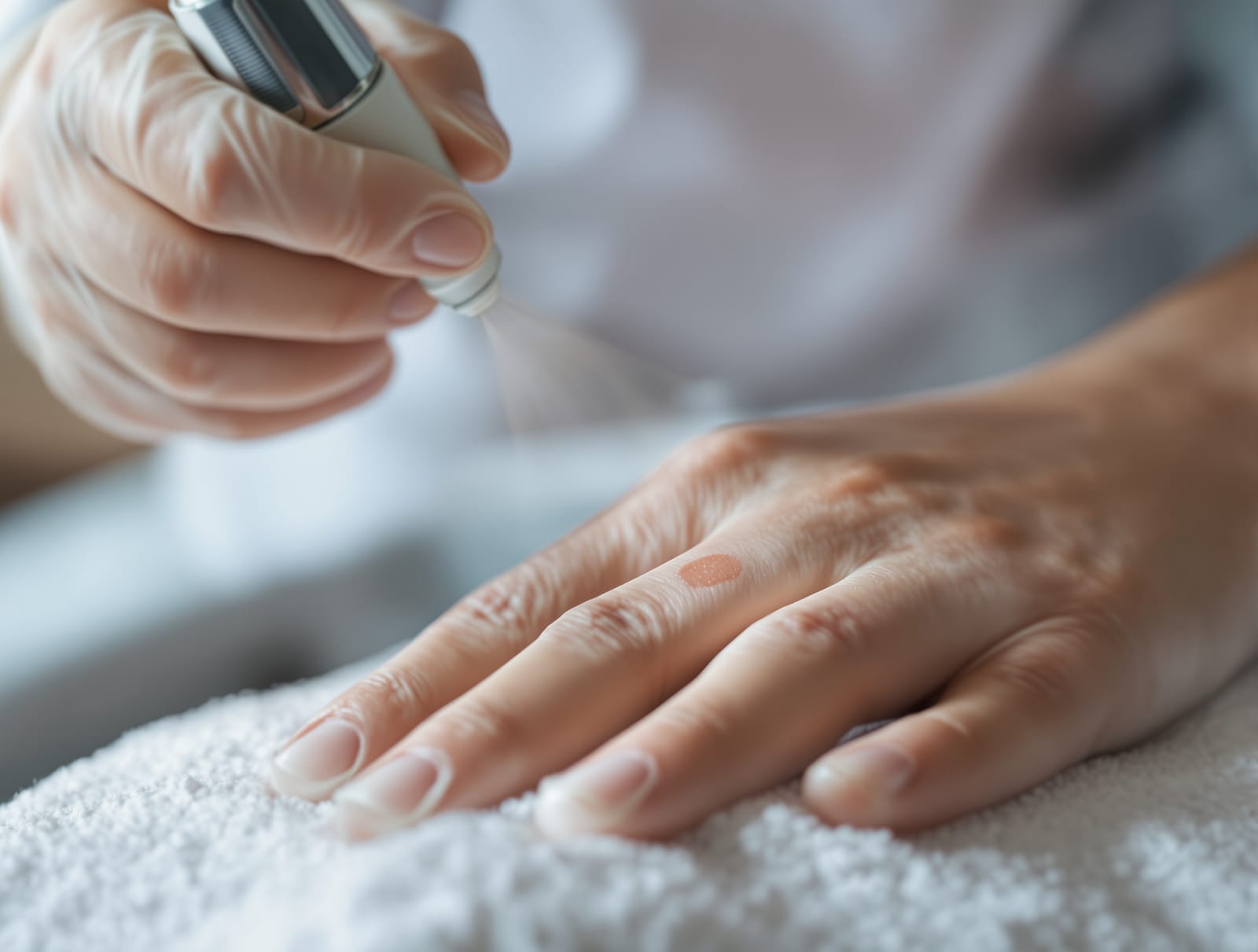
Of all the ways to remove an age spot, cryotherapy is the one most people have already had done without thinking about it. A dermatologist reaches for a canister of liquid nitrogen, sprays or dabs the spot for a few seconds, and moves on to the next one. It is fast, it is inexpensive, and it is one of the oldest tools in the dermatology cabinet. But freezing a sun spot is not as simple as it looks, and it carries a specific risk that surprises patients who were not warned about it.
What Cryotherapy Actually Does to a Spot
Cryotherapy works by cold injury. Liquid nitrogen reaches roughly minus 196 degrees Celsius, and when it is applied to skin it freezes the water inside cells, forming ice crystals that rupture cell membranes. Melanocytes, the pigment-producing cells that create age spots, happen to be unusually sensitive to cold. They begin to sustain damage at temperatures far milder than the ones that harm surrounding keratinocytes. That selective vulnerability is the whole basis of the treatment: a brief, shallow freeze can knock out the overactive pigment cells in a solar lentigo while largely sparing the tissue around them.
After treatment the spot typically reddens, sometimes blisters, then forms a small crust that flakes off over one to two weeks, taking the excess pigment with it. According to the American Academy of Dermatology, cryosurgery is a standard, well-established option for benign lesions including solar lentigines, and most spots need only a single short application.
Who It Suits, and Who Should Be Cautious
Cryotherapy is best for isolated, well-defined spots on fair skin, particularly on the hands, forearms, and face. It is quick, requires no special equipment beyond the nitrogen, and usually costs less than a laser session. For someone with a handful of discrete lentigines, it can be an efficient one-and-done choice.
The caution is skin tone. Because the freeze damages pigment cells, it can leave a pale, depigmented patch where the spot used to be, a complication called hypopigmentation. In medium-to-deep skin, that white mark can be more noticeable and more lasting than the original brown spot. The same cold injury can also trigger the opposite problem: post-inflammatory hyperpigmentation, in which the treated area darkens as it heals. The National Institutes of Health literature on cryosurgery notes both hypopigmentation and pigment change among the most common cosmetic side effects, which is exactly why many clinicians steer patients with richer skin tones toward gentler options.
How It Compares to Lasers and Peels
The honest comparison is about precision and control. A Q-switched or picosecond laser lets the operator dial in energy and target pigment with far more finesse than a hand-held spray of nitrogen, which is part of why lasers have become the default for cosmetic pigment work in experienced practices. Cryotherapy is blunter: freeze depth and duration are estimated by feel and experience, and a freeze that is a second too long is what produces the pale spot afterward.
Where cryotherapy still wins is speed, cost, and availability. Not every clinic owns a pigment laser, but almost every dermatology office has liquid nitrogen on hand. For a single spot on fair skin, in skilled hands, the outcome can be excellent. The Mayo Clinic lists freezing among the standard in-office treatments for age spots, alongside lasers, chemical peels, and prescription creams, precisely because it remains a reasonable tool for the right lesion.
Aftercare and the Sun Problem
Aftercare is simple but not optional. Keep the treated area clean, resist picking the crust, and protect it obsessively from the sun while it heals. Freshly healed skin is highly prone to darkening, so a fading treatment followed by unprotected sun can hand you a new spot in the same place. As with every pigment treatment, the freeze removes the spot that is there; it does nothing to stop the biology that made it. Daily broad-spectrum SPF is what keeps the result.
The Bottom Line
Cryotherapy is a legitimate, evidence-backed way to remove age spots: fast, affordable, and widely available. Its weakness is precision. On fair skin with isolated spots, it is often an efficient choice. On medium-to-deep skin, the risk of a lasting pale patch is real enough that a laser or a topical program is usually the smarter route. As always, the value of a consultation is that a dermatologist can tell you which tool fits your skin before anyone reaches for the nitrogen.
Related reading: At-home vs. in-office fading: an honest comparison.