
Explainer · July 22, 2026 · 7 min · By Marisol Etcheverry
Age spots on darker skin tones: why the safe treatment list is shorter
The same pigment cells that built the spot will also react to whatever you use to remove it. On brown and Black skin that turns aggressive fading into a real risk, and it changes which tools belong in the plan.
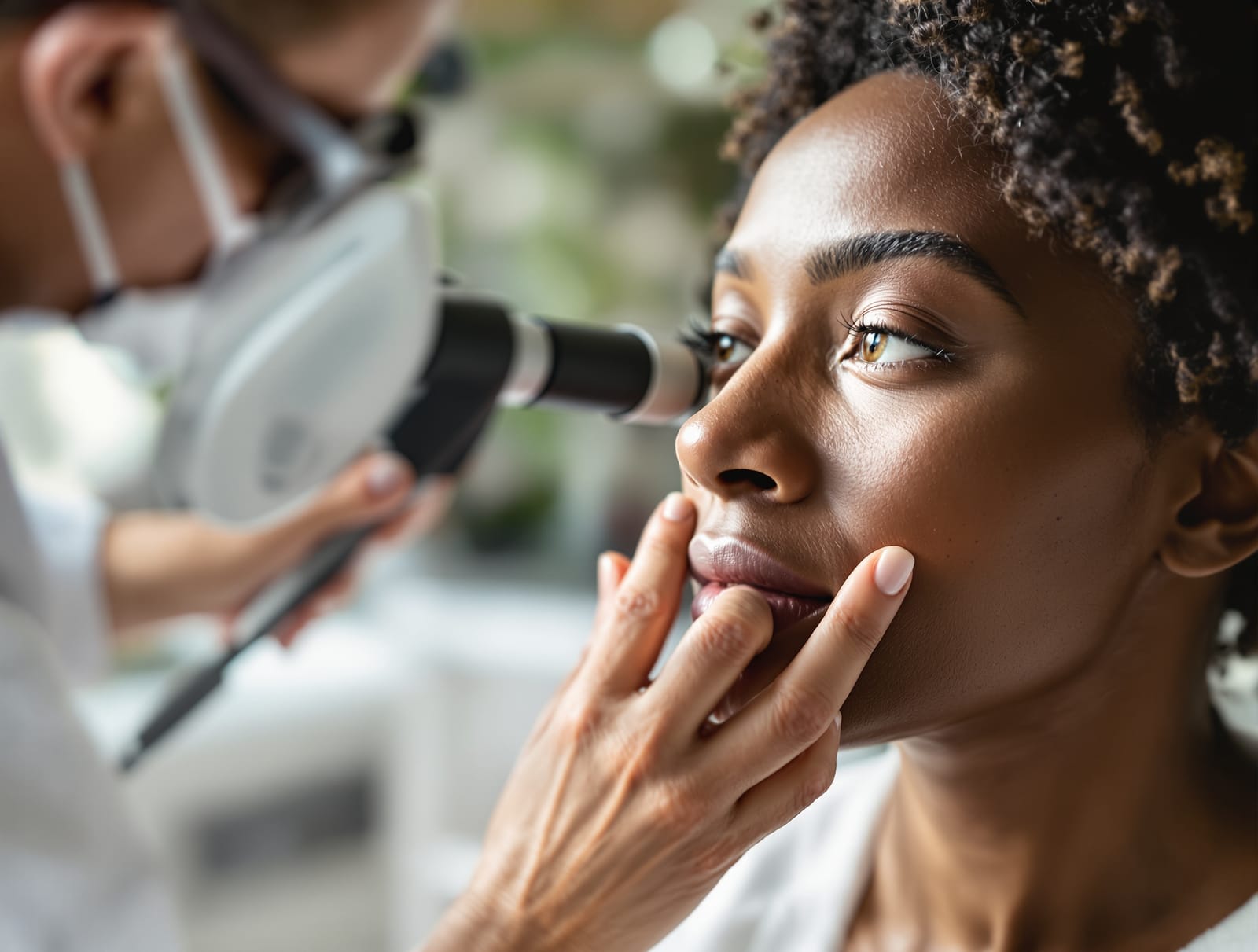
On very fair skin, a stubborn brown spot is mostly a cosmetic nuisance and the treatment menu is long. On brown and Black skin the math changes, because the same melanocytes that built the spot will also react to whatever you use to erase it. Heat, abrasion, and inflammation are all signals to make more pigment. That means a device setting that clears a sun spot cleanly on a Fitzpatrick type II patient can leave a darker, wider stain on a type V one, and the stain can outlast the original spot by a year. The safe list is genuinely shorter, the pace is slower, and the order of operations matters far more. Here is what holds up.
Why Darker Skin Reacts Differently
Melanocyte density is roughly the same across skin tones. What differs is output and behavior: in richly pigmented skin the melanosomes are larger, more numerous, and more readily dispersed, and the pigment system is quicker to switch on after any insult. Dermatologists call the result post-inflammatory hyperpigmentation, or PIH, and it is one of the most common complaints in skin of color practice. A widely cited review in the Journal of Clinical and Aesthetic Dermatology describes PIH as occurring with greater frequency and greater severity in Fitzpatrick types IV through VI, and notes that it can follow acne, eczema, a bug bite, a scratch, or a cosmetic procedure (PMC, NIH).
That is the whole problem in one sentence. Any treatment that works by wounding the skin is also a treatment that can trigger the exact pigment response you are trying to remove. The goal is not to avoid treatment. It is to pick the tools with the lowest inflammatory cost and to move slowly enough that the skin never gets a reason to overreact.
First, Confirm It Is Actually an Age Spot
This step gets skipped constantly and it wastes the most money. A true solar lentigo is a flat, well-defined tan-to-brown patch driven by cumulative sun exposure, and it sits on the areas that catch the most light: the cheekbones, the temples, the backs of the hands, the upper chest. What frequently gets mistaken for it in darker skin is PIH from old acne, which is browner, more irregular, and clustered where breakouts were, and melasma, which is symmetric, patchy, hormonally driven, and famously prone to rebound after aggressive treatment. The three look similar under bathroom light and respond to completely different plans. StatPearls notes that distinguishing PIH from other pigmentary disorders is the first step in management, because the treatment ladder diverges immediately (StatPearls, NCBI). Get a dermatologist with a dermatoscope to tell you which one you have before you buy anything.
The Topicals That Do the Heavy Lifting
In skin of color, topicals are not the consolation prize. They are the main event, because they fade pigment without wounding tissue. The AAD guidance for fading dark spots in darker skin tones points to azelaic acid, glycolic acid, kojic acid, retinoids, and vitamin C as the useful over-the-counter actives, with prescription-strength hydroquinone reserved for stubborn cases under supervision (AAD).
Two practical notes. First, azelaic acid deserves more attention than it gets here: it inhibits pigment production, calms inflammation, and is well tolerated, which makes it close to ideal when the skin is already prone to overreacting. Second, tranexamic acid has become a favorite for pigment that has a vascular or hormonal component, and it pairs well with the classic brighteners. Start one active at a time, give each eight to twelve weeks, and stop immediately if anything stings, flakes, or reddens for more than a few days. Irritation in this context is not the treatment working. It is the mechanism that creates the next dark spot.
Where Devices Get Risky
Intense pulsed light is the tool most likely to cause trouble. IPL fires a broad band of wavelengths and relies on the pigment in the target being darker than the pigment in the surrounding skin. When background melanin is high, the surrounding skin absorbs energy too, and the result can be a burn, a blister, or a permanent light patch where pigment cells were destroyed. Most experienced clinicians simply do not use IPL above Fitzpatrick type III for this reason, and the ones who do use it cautiously and at low fluence. Our comparison of IPL and Q-switched lasers covers how the two devices differ in selectivity. Deep ablative resurfacing carries the same objection, amplified.
The Devices That Are Safer, With Caveats
Devices are not off the table, they just have to be chosen for selectivity rather than power. Q-switched and picosecond lasers deliver energy in extremely short pulses that shatter pigment granules with minimal heat spread to surrounding tissue, which is why they are the usual choice when a device is warranted in darker skin. Low-fluence settings, longer wavelengths, conservative spacing between sessions, and a test spot in an inconspicuous area are all standard practice. Superficial chemical peels, particularly low-concentration glycolic or salicylic acid, can also be used safely, but only after several weeks of topical priming and with the understanding that going deeper is not better here.
The single most important variable is the operator. Ask directly how many patients with your skin tone the provider treats, what settings they use, and whether they will do a test spot. A provider who cannot answer those questions specifically is not the right provider.
Sunscreen, and the Visible Light Problem
Every plan collapses without daily photoprotection, and in darker skin there is a wrinkle: pigment cells in richly melanated skin respond not only to ultraviolet light but to visible light, the ordinary light coming through a window or off a screen. Standard mineral and chemical sunscreens do little against it. The fix is a tinted sunscreen, because the iron oxides that create the tint are what block visible light. The AAD makes this explicit in its guidance for darker skin tones, recommending broad-spectrum SPF 30 or higher with iron oxide. Tinted, daily, reapplied. This is not optional maintenance, it is the reason age spots keep coming back after otherwise successful treatment, and our sunscreen guide covers the application details most people get wrong.
A Realistic Timeline
Set expectations at months, not weeks. The AAD notes that fading can take six to twelve months for lighter discoloration and considerably longer when pigment sits deeper in the skin. That is not a failure of the plan, it is the normal pace of pigment turnover, and trying to accelerate it with stronger acids or hotter device settings is precisely how people end up worse off than when they started.
The Bottom Line
In skin of color, the winning strategy for age spots is patient and topical-first: confirm the diagnosis, build on azelaic acid or a retinoid with tranexamic acid or vitamin C alongside, wear tinted sunscreen with iron oxide every single day, and reserve devices for a provider with real experience in your skin tone using short-pulse lasers at conservative settings. Avoid IPL and deep peels unless someone can give you a very specific reason otherwise. The shorter list is not a lesser list. It is the one that does not trade a flat brown spot for a darker one that lasts a year.
Related reading: Melasma vs. age spots: similar look, different fix.
More in Explainer
View all →- Sun spots on skin: the four-question sort that tells you which of four things you actually have
- What causes liver spots: the dose ledger your skin has been keeping
- What Are Age Spots, Really? Three Definitions, and Where They Disagree
- Why Age Spots Shrug Off Most Fading Creams, and What Actually Works on Them